Monday, February 23, 2009

Hillary Unchained?

Courtesy of the WaPo, comes a heartening bit from SecState Clinton's inaugural jaunt through Asia:

BEIJING, Feb. 22 -- Hillary Rodham Clinton's blunt and unadorned style of diplomacy has been evident throughout her first trip as secretary of state the past week in Asia. She questioned the efficacy of sanctions against the repressive junta in Burma, spoke openly about a possible succession crisis in North Korea and admitted that she expected to make little progress on human rights in China.

To a certain extent, these comments crossed taboo lines in international diplomacy. U.S. officials generally do not say their sanctions have failed, or speculate about the future government of another country, or suggest that a carefully watched human rights dialogue is largely a farce.

Clinton's willingness to speak frankly -- combined with an extensive effort to get beyond ministerial meetings in order to hold town hall meetings and conduct local television interviews in the countries she visits -- suggests she will put a distinctive personal stamp on the Obama administration's foreign policy. What is emerging is something less rigid, less cautious and more open.

Before her meetings in Beijing, for instance, Clinton said she would raise human rights issues with Chinese officials, "but we pretty much know what they're going to say."

Readers will recall that I've been guardely sanguine about Hillary as SecState. This story does nothing to disabuse me of my initial optimism. In her statements about the human rights record in China, she is either being very savvy or very foolhardy. Not surprisingly, the situation is more-than-ably summarized by John Bolton:

Former U.N. ambassador John R. Bolton, who was known for his bluntness, said he thinks "our diplomacy should be more candid, with less doublespeak, so if she really meant to say what she said, I don't mind at all. When the Democrats endorse candor in diplomacy, I'll be a happy man."

But he added: "The issue with whatever she says, candid or not, is whether it has an objective in mind, or whether she is just running at the mouth. This is the difference between an executive branch official and a senator, academic, think-tanker, reporter, whatever. Executive branch officials, by definition, are not just bloviating, but executing policies."

And that, really, is the heart of the matter. If Hillary is publicly setting up shamefully low expectations for the Chinese, while gearing up to privately develop face-saving alternatives in the area of human rights, all the while preserving the critical economic and political interconnections which are so fundamental to globalization, then she is showing herself to be a formidable and subtle operator in line with her greatest strengths, for the service of American interests (to say nothing of long-suffering Chinese). If she is just blowing smoke, which she will trap in a cynical ionizing filter of nuance over the days to come, then she is acting on the worst expectations of geopolitical fecklessness which Obama's campaign threatened.

For the moment, though, allow me to register one qualified "attagirl!"

Monday, February 16, 2009

Handy Political Compass Quiz

In case you haven't noticed, I've not had much in the way of surplus energy/time for blogging of late. Stubbornly persistent flu, a burst of practice-building efforts, and General Life Stuff have intervened, as they are wont to do (as any of you who are acquainted with any three year-olds doubtless know, the task of being an outboard superego for such a beast is a formidable one!).

And, of course, I am still scrambling up the learning curve in search of secure footing in reconciling myself to the current occupant of a certain House on Pennsylvania Avenue.

So, in the meantime, I thought I would pass along a useful little quiz for identifying one's position on a variety of dimensions of political thought:

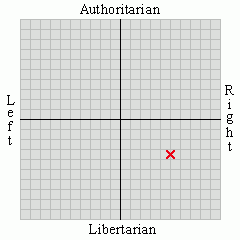
This quiz will let you know where you fall on social liberties, economics, foreign policy-- even the culture war. In truth, this isn't a quiz so much as a set of statements that you must agree or disagree with. Based on your responses we will place you on a graph--also termed a political compass--that separates social liberties from economic opinion.


Such quizzes are a dime a dozen, and most are pure crap. However, the results of this one lined up pretty intuitively with how I informally assessed my evolving political views. For giggles, I herewith present my results:

My
Political Views

I am a right moderate social
libertarian
Right: 5.15, Libertarian: 3.34


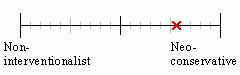
My
Foreign Policy Views

Score: 5.56


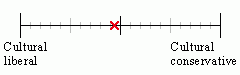
My
Culture War Stance

Score: -0.62


I thought it might be entertaining for any readers out there to have a go at this, and see where they stand/fall. If nothing else, it might make for some good sport in the Comments section!

Have at it!

Sunday, February 15, 2009

Required Reading on Afghanistan

Courtesy of FormerSpook, comes this lengthy but indispensable essay by Fred Kagan on the challenges facing General Petraeus and the Obama Administration as we prepare to ramp up our efforts in the Af-Pak theater. As I have written previously, the tasks of adapting the sophisticated counterinsurgency (COIN) strategy which has been so successful in Iraq to the profoundly different terrain and cultural milieu in Afghanistan represents a formidable set of tests for the resiliency and resolve of our military and diplomatic corps. Kagan lines up nine general categories of challenges which we face, and offers suggestions on how to develop plans to overcome them.

Those of us who are diligently watching the fledgling Obama administration's handling of the geopolitical tasks which it has inherited would do well to read this essay very carefully, and to pay very close attention to the signs that its prescriptions are being followed. This is one which Obama absolutely has to get right, and simply throwing troops into the theater without such a carefully thought-out strategy is a recipe for a very costly disaster. Still, Obama has so far been smart enough to keep Bob Gates on as SecDef, and has shown no inclination to mess arround with the command structure of our military (most notably, he has tasked CENCOM head General Petraeus with developing the strategy for winning in Afghanistan. Very good sign, that). This is going to be a very difficult campaign, requiring steadfast and intelligent committment. Let us hope most fervently that Obama is made of the sort of stuff which it will take to see us through it. As Kagan sums up:

This essay does not provide a plan or a strategy for success in Afghanistan. It provides, rather, a set of guidelines for thinking about how to develop one, and for evaluating plans articulated by the administration, its generals, and outsiders. Ultimately, a plan for winning in Afghanistan has to be developed in Afghanistan, just as the plan for winning in Iraq was developed in Iraq. It is a truism that any plan must involve not only the U.S. and allied militaries, but all relevant civilian and international agencies, and must deeply involve the Afghans themselves at every level. Our military and civilian leaders understand that truism. We have failed to date in accomplishing the objective not because we haven’t known that we must, but because it is very hard to do.

But hard is not hopeless in Afghanistan any more than it was in Iraq. The stakes are high, as they always are when
America puts its brave young men and women in harm’s way. President Obama has an opportunity in the difficult challenge he faces. So far, he appears determined to try to do the right thing. He deserves the active support and encouragement of every American in that attempt.


Again, Obama has seen fit to keep some very capable people at the reins of this very balky beast. Let us Hope that he gives them everything they need on the dark and dangerous path they must walk.

Wednesday, January 21, 2009

Plus Ca Change...

I don't care who you are, that's funny right there...


The Guarding of the Change

I fought it all day. I focused on things like this (a splendid article, about which I intend to blog soon). I lingered on the joy and satisfaction which my friends were experiencing (that one came the closest to working). I pondered the wonder of the peaceful, seamless transition of power in our Republic, and looked into the earnestly well-wishing, gracious, and satisfied yet wistful face of our outgoing President as he handed over the keys.

All to little effect. Today, I have decided, I shall surrender to the impulse to be a sourpuss about our new POTUS.

This is not a difficult place to come to, mind you. The endless hagiographic swooning by a media whose indecently, leg-tinglingly transparent bias had no small hand in this election's outcome fills me with nausea. The transports of vacuous ecstasy in the faces of pampered celebrities (many of whom would likely fare worse on a basic civics quiz than a fair number of migrant workers in a California vineyard) have made me seriously consider revising my quaint notions of intellectual property and looking to hitherto-eschewed bittorrents. The earnest gum-flapping of assorted congresscritters on matters of "bipartisanship" (after years of hyperpartisan derangement) in This New Era have induced almost tourettes-like eruptions of random bile which appear to have aroused sincere concern in the face of my dog.

All around, there are breathless perorations about how All Things Are Possible Now, piquant prognostications about the end of divisiveness and the mending of our Nation, yadda-yadda...all of which sound unnervingly like conclusions in search of premises. More than anything, it appears that the American and international media have circled the wagons against anything which might threaten to pierce the bubble on which the One has drifted to his apotheosis.

For today, at least, I remain largely unmoved. The very notion that a government figure can solve our problems is offensive to me. That an eloquent but untried government figure might, by dint of the sheer force of his personality cash the checks that all of his allies in the Fourth Estate have helped him to write leaves me sputtering and gagging.

Tomorrow may be different. Indeed, I know myself well enough to have faith that a more equitable blend of kudos and criticisms will ultimately prevail (in the end, I know that I am not That Guy...you know, the one who stands in his bathrobe, intermittently barking obscenities at the radio). No Obama Derangement Syndrome for me.

For today, however, secure in this knowledge, I have chosen to indulge myself in an orgiastic bender of grumbling misanthropy. As ever, your mileage may vary.

A handy "To Don't" List for the Right

From Andy Levy, via breitbart. Worth reading. The last one struck a particularly true note:

And finally, DON’T use the fact that many on the left behaved abominably for the past eight years as an excuse to behave the same way. America needs adults. And if it bothered you when they did it, it’s a good sign that you shouldn’t do it.

Tuesday, January 13, 2009

Humanitarian Aid, "Palestinian" Style

Via Hot Air comes this instructive little tidbit.

Hamas on Monday raided some 100 aid trucks that Israel had allowed into Gaza, stole their contents and sold them to the highest bidders.

The IDF said that since terminal activity is coordinated with UNRWA and the Red Cross, Israel could do nothing to prevent such raids, Israel Radio reported.

Between 10 a.m. to 1 p.m., the army had ceased all military activity in Gaza and once again established a "humanitarian corridor" to help facilitate the transfer of the supplies.

The Kerem Shalom and Karni crossings had been opened to allow in the aid trucks.

So, to be clear, the IDF periodically halts its defensive war against terrorists bent on its destruction in order to allow the delivery of humanitarian aid to the innocents who are routinely placed in harm's way by those terrorists. Then the aforementioned terrorists hijack those aid supplies, sell them off to those who can afford to pay (thus letting those who can't pony up simply continue to face starvation), in order to raise funds to continue their war of extermination against the providers of that aid.

Clearly, this must be the fault of the Israelis, yes? It must be part of some twisted Zionist conspiracy to subvert Islam and re-occupy the territory which it unilaterally ceded to the "Palestinians" (who then went on to raze every bit of useful infrastructure which the Israelis had left behind, and replace it with...slums and rocket launchers). Here's your proof:

Meanwhile, Israel is considering establishing a field hospital in the Gaza Strip to treat Palestinian civilians wounded in fighting between the IDF and Hamas.

The plan would be to establish the field hospital outside the Gaza Strip, but the IDF is also considering the possibility of erecting the hospital inside the Palestinian territory so it will be more accessible to the Palestinian population. It would be run by the IDF Medical Corps.

Clearly, this "hospital" is merely a thinly-veiled move by Israel to steal territory it previously gave away, and restore to health those innocents who were accidentally hurt in its campaign, so that they will...what? Live on to become subjects of the Zionist Entity?

It is a rare thing in life for a situation to be this clear. Those who persist in distorting this conflict to support their reflexive antipathy toward Israel continue to astound me with the cognitive gymnastics in which they must engage to obscure the blindingly obvious.


EDITED for the sake of pronouns feeling lonely without antecedents.

Sunday, January 4, 2009

Disproportionate

As the Israeli Defense Force continues with its thus-far exceptionally precise and comparatively humane effort to rid the Gaza Strip of the murderous thugs who have rained unguided anti-personnel rockets on civilian targets, the predictable and tedious cries about "proportionate" responses have risen like flies from carrion. Like many commentators, I am left scratching my head as to what exactly would constitute a "proportionate" response to Hamas' campaign to kill as many Jews as it can, with the explicitly avowed end of eradicating the Jewish State. Targeted assassinations of terrorists and murderers are decried as craven murder. Bombing of known strongholds and weapons caches is vilified for the accidental casualties incurred among the civilians among whom those weapons (which are themselves deliberately aimed at civilians) are stored. The destruction of Mosques raises especially strident cries of "war crime!" among those for whom Israel is invariably portrayed as the default villain. Places of worship are supposed to be sanctuaries where humans seek the higher callings of their better natures, after all...

What then are we to make of the below-embedded video depicting the destruction of a Gazan Mosque? It is no secret that, like many religious texts, the Koran contains a number of explosive passages. However, this may be an example of scriptural literalism raised to an unusually direct level.


Monday, December 29, 2008

Water, Water Everywhere?

The latest findings from the Mars Reconnaissance Orbiter offer some promising signs that the early aqueous environment on Mars was not the acidic mess that some had theorized. The presence of carbonates in key strata of Martian bedrock argue convincingly for a neutral-to-alkaline composition of past Martian waters (since an acidic environment would dissolve the carbonate in short order). This in turn suggests that conditions were favorable (or at least not brutally hostile) for the emergence of life as we know it in ancient Martian surface water.

You can see on this map that the orbital assay has revealed carbonate in several equatorial regions of the Martian landscape. The fact that carbonates were also detected by the Phoenix lander on the northern polar plains suggests that relatively hospitable waters were once found in widely distributed regions of Mars in the ancient past.

Does this mean that life once existed on our neighboring planet? Insufficient data. But it should be noted that life appears to have emerged on the young, cooling Earth almost immediately (in geological time). This suggests that the processes which lead to the complexification of organic molecules into self-organizing, pre-biotic hypercycles can occur quite readily when conditions permit. I have a sneaking suspicion that more detailed study will yield evidence of at least primitive life having existed on Mars in the distant past. Whether some life still exists (e.g., in deep aquifers kept liquid by the planet's internal heat) is very much an open question.

As immense a find as that would be, I actually hope we find that life flourished on Mars for one brief, shining moment, then slipped into oblivion. The presence of extant life on Mars would greatly complicate the ethics of eventual colonization, given the immeasurable scientific value of coming to understand the biology of a separate cradle of life in our own solar system. But that's a question for another day. For now, it is very exciting to have begun to solve the riddle of the missing carbonates, and so moved one step closer to the discovery of a "second Creation," and thence to the tantalizing indication that our universe may in fact be teeming with life.

Might make stargazing a rather less lonely experience.

Sunday, December 21, 2008

Hopes

Needless to say, posting has been almost embarrassingly light this month. Part of this, I'm sure, can be attributed to the impending Holidays, and their effects on my schedule (think three-dimensional Tetris). Plans to travel and see family, coupled with attempts to squeeze clients into time-slots, while accommodating various vacations and exams (most of my clients are teens and 20-somethings) have had their impact on blogging.

However, if I'm to be entirely honest, I must confess that the outcome of the election has had an impact on me. At first, there was a kind of depression (not so much clinical/personal --I'm not that far gone-- as blogospheric). I'd devoted so much energy to the candidates' qualifications and positions, debunking and exposing and advocating and warning and generally obsessing, that the end of it all left me rather spent.

Also, I have not wanted to be the one who prematurely blasted or gave a pass to the President-Elect. I have been surprisingly sanguine about his appointments to foreign-policy-relevant Cabinet positions; there are signs there of a degree of maturity and pragmatism which frankly I did not expect to see from Obama. Keeping Bob Gates on as Sec Def was an intelligent and politically risky move, for example. I'm not even displeased with Hillary as Secretary of State; she is, if anything, a canny and pragmatic politician, a master triangulator, and a moderate on the Hawk-Dove continuum. Sec State was arguably the role she was born to play. Other appointments have left me rather more wary...which is a subject for another day.

In short, Obama has so far earned a wait-and-see attitude from me, which is quite astonishing, considering his campaign persona and the blindingly foolish things coming out of his mouth as he contended with John McCain for the Big Chair. I suppose the realities of governing have had the hoped-for effect on his policies, a moderating and focusing effect which is inevitably --for someone who is truly intelligent-- going to be at variance with the need to inspire an electorate to cast its vote. I live in hope that reality continues to mug the POTUS-Elect, and that he continues to exercise the sort of political jujitsu for which one can only hope a street fighter like Rahm Emmanuel will be able to provide cover against the unalloyed horror embodied by the likes of Pelosi and Reed.

Meanwhile, before the subject of McCain drops too far in the rear-view, I direct your attention to an editorial from the WaPo, by Sens. McCain, Lieberman, and Graham, in the wake of their recent trip to Iraq. Their observations embody the sort of careful optimism which the near-miraculous turnaround in Iraq has inspired in so many of those who are able to shed the goggles of partisanship long enough actually to look at what has been transpiring there:

Based on our observations and consultations in Baghdad, we are optimistic that President-elect Obama will be able to fulfill a major step of his plan for withdrawal next year by redeploying U.S. combat forces from Iraq's cities while maintaining a residual force to train and mentor our Iraqi allies. We caution, however, that 2009 will be a pivotal year for Iraq, with provincial and then national elections whose secure and legitimate conduct depends on our continued engagement. By allowing a greater number of forces to remain in Iraq in the short term, we will be able to set the conditions for much deeper troop cuts thereafter.


Really, there is nothing new here; this has always been the plan: stay long enough to stabilize the situation, allow the government to dig in and prove its legitimacy, and train up the Iraqi military and police to the point that they can function as a modern, professional force in the service of the Iraqi people's interests, guided by civilian leadership which will set sound policy. Then pull out in a responsible manner, and let the Iraqi people chart their own course. The difference is that those goals are far less abstract than they once were. Indeed, they are very much in sight.

Just as the destiny of Iraq was very much in question as little as 18 months ago, so the nature of an Obama Administration's strategies and tactics were a terrifying cipher until recently. It is my considered opinion that there are unexpected grounds for hope on both fronts. It is still my belief that McCain would have been a simply superb President (a statement which is likely to draw considerable fire from both Liberals and Conservatives who may read these words). But I am starting to see that Obama may not prove the unmitigated disaster I'd been so certain he would be (ditto!).

I have not forgotten that Obama opposed the change in strategy which has made the current situation in Iraq possible. The fact that he has shown indications of being able to respond intelligently to current conditions is not prima facie evidence that he will have the wherewithal to craft and implement policies which will result in similarly favorable conditions in the future. There will likely be only a short span in the early days of his presidency during which he can ride the coattails of --and vehemently disavow-- the accomplishments of Bush's foreign policy team. After that, he is on his own. Interestingly, this is something which he and Nouri al Maliki share.